- Autoría
- Boyce Rensberger
- Edición
- Oxford University Press, USA, 1998
- Nivel
- Divulgación
- Idioma
- Inglés
- ISBN
- 9780195125009
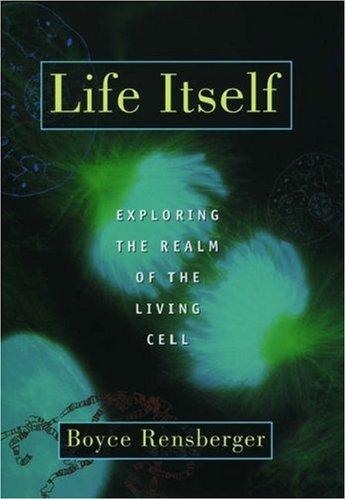
In Life Itself, Boyce Rensberger, science writer for The Washington Post, takes readers to the frontlines of cell research with some of the brightest investigators in molecular, cellular, and developmental biology.^
Virtually all the hottest topics in biomedical research are covered here, such as how do cells and their minute components move? How do the body's cells heal wounds? What is cancer? Why do cells die? And what is the nature of life? Readers discover that - contrary to what we may have concluded from pictures in our high school textbooks - cells teem with activity and that, inside, they "are more crowded with components than the inside of a computer." We learn that scientists now know of at least ten molecular motors that move things about inside the cell - in most cells, this motion is short because the cell is tiny, but in the single-celled nerve fibers that run from the base of the spinal cord to the toes (measuring three or four feet in an adult human), transported molecules can take several days to make the trip.^
Seguir leyendo
Rensberger describes the many fascinating kinds of cells found in the body, from "neural crest cells" (early in embryonic development, these cells crawl all over the embryo to the sites where they will pursue their fate - as nerve cells, or cartilage, or skin), to "dust cells" (nomadic cells in the lung that swallow and store indigestible particles, then migrate to the gullet where they themselves are swallowed and digested), to "natural killer cells" (millions of which roam the body looking for cancerous cells). We meet many of the scientists who have pioneered cell research, such as Rita Levi-Montalcini - an Italian who, shut out of her lab during World War II, continued to experiment in her bedroom at home, making the discovery ("nerve growth factor") for which she won the Nobel Prize - and American Leonard Hayflick, who discovered that all human cells (except cancer cells) invariably die after about fifty divisions.^
Rensberger also p
Algunos enlaces son de afiliación: si compras a través de ellos, podemos recibir una pequeña comisión sin que te cueste más. Gracias por apoyar el sitio.