Universitario · En inglés
The Descent of Man and Selection in Relation to Sex
Charles Darwin
IndyPublish.com, 2003
Libros
Charles Darwin · Tantor Media, 2006
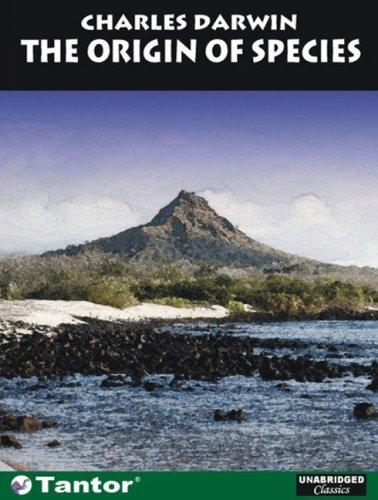
On December 27, 1831, the young naturalist Charles Darwin left Plymouth Harbor aboard the HMS Beagle. For the next five years, he conducted research on plants and animals from around the globe, amassing a body of evidence that would culminate in one of the greatest discoveries in the history of mankind-the theory of evolution.Darwin presented his stunning insights in a landmark book that forever altered the way human beings view themselves and the world they live in. In The Origin of Species, Darwin convincingly demonstrates the fact of evolution: that existing animals and plants cannot have appeared separately but must have slowly transformed from ancestral creatures.
Most important, the book fully explains the mechanism that effects such a transformation: natural selection, the idea that made evolution scientifically intelligible for the first time.One of the few revolutionary works of science that is readily accessible to the nonscientist, The Origin of Species not only launched the science of modern biology but has also influenced virtually all subsequent literary, philosophical, and religious thinking.
Otras opciones
La compra desde el enlace de Amazon puede dejar una comisión. El precio es el de la tienda.
Universitario · En inglés
Charles Darwin
IndyPublish.com, 2003
Divulgación · En inglés
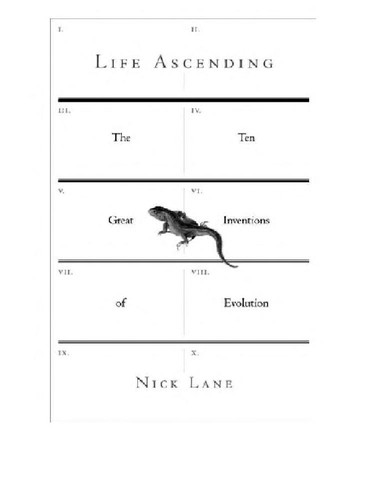
Nick Lane
Norton, 2010
Draws on cutting-edge scientific findings to chronicle the history of biological life, exploring a wide range of clues from gene sequences to the atomic structures of proteins to identify 10 key evolutionary developments that enabled consciousness, the creation of DNA and other building blocks. Reprint. A Scientific…
Universitario · En inglés
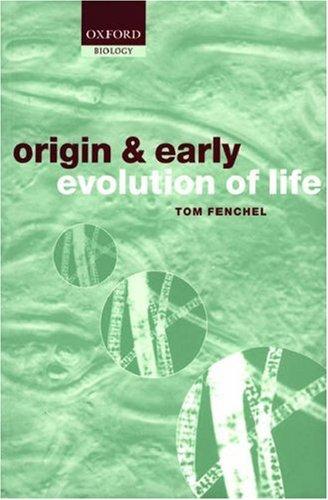
Tom Fenchel
Oxford University Press, USA, 2003
Origin and Early Evolution of Life draws on evidence from molecular genetics, the structure and function of extant organisms, and geology. It covers the period from about 4 billion years ago, when life is thought to have originated, to about 600 million years ago when multicellular organisms first arose. There are…
Divulgación
Richard C. Lewontin
Ediciones Paidos Iberica, 2002
¿Está determinada nuestra naturaleza --como individuos, como especie-- por nuestra evolución y codificada en nuestros genes? Si analizamos las secuencias de proteínas de nuestro ADN, ¿podremos curar cualquier aflicción fisiológica y psicológica e incluso resolver los problemas sociales más importantes? Hoy en día, los…
Divulgación
James D. Watson
Alianza, 2005
By identifying the structure of DNA, the molecule of life, Francis Crick and James Watson revolutionized biochemistry and won themselves a Nobel Prize. At the time, Watson was only 24, a young scientist hungry to make his mark. His uncompromisingly honest account of the heady days of their thrilling sprint against…